Barite is one of the most essential minerals in drilling operations. Here’s what makes it critical, and what to check before you source it.
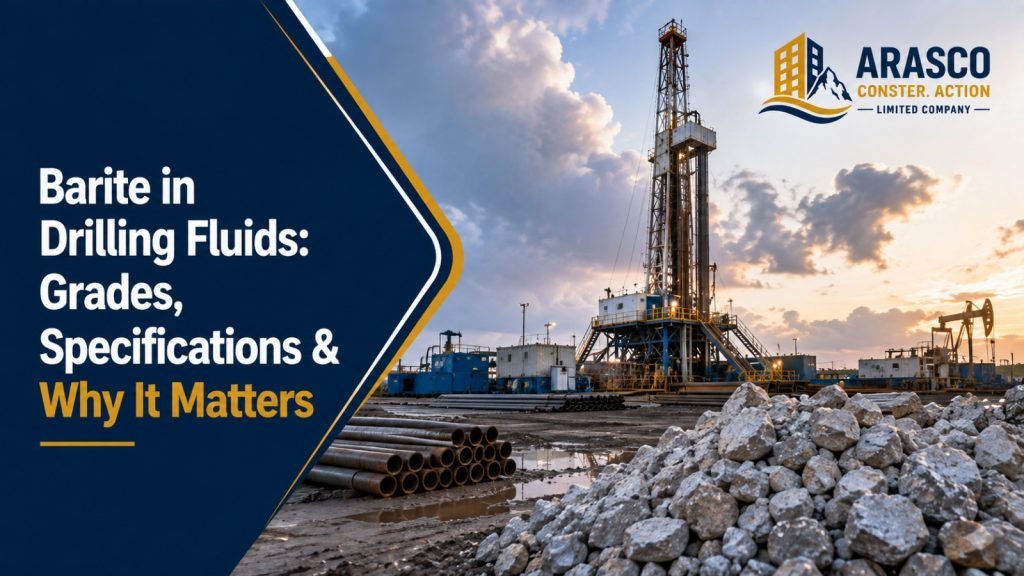
Drilling operations depend on one thing above all else: a stable, well-controlled wellbore. Behind that stability is a mineral that rarely gets the spotlight — Barite. As a weighting agent in drilling fluids, Barite plays a direct role in managing downhole pressure, preventing blowouts, and keeping drilling operations safe and efficient.
What is Barite?
Barite (Barium Sulphate) is a naturally occurring mineral valued for its high specific gravity. When ground into fine powder and mixed into drilling mud, it increases the fluid’s density, allowing it to counteract the pressure of formations being drilled through. Without adequate weighting, drilling fluid cannot control downhole pressure, which can lead to serious safety and operational risks.
Grades & Specifications
Not all Barite is created equal, and this is where many buyers run into trouble. Drilling-grade Barite is typically supplied against API 13A specifications, which define requirements for density, particle size, and impurity levels. Depending on the operation, customers may require:
- API Grade Barite — for standard oilfield drilling applications
- High-density / micronized Barite — for deep and high-pressure wells
- Custom-ground Barite — sourced to specific mesh sizes per customer requirement
At Arasco, we source Barite from verified producers who process to these exact grades, and we carry out our own quality checks before supply — giving us control over consistency from source to delivery.
Industries & Applications
While Barite is best known in oil & gas drilling, its applications extend further:
- Oil & Gas Exploration — primary use as a weighting agent in drilling mud
- Oilfield Services Companies — bulk supply for ongoing drilling programs
- Radiation Shielding & Construction — Barite’s density is also used in specialty concrete and shielding applications
- Paints, Rubber & Plastics — as a filler material in certain industrial formulations
What to Look for When Sourcing Barite
Because Barite quality directly affects drilling performance, buyers should never source on price alone. A few things worth checking before placing an order:
- Specific gravity consistency — batch-to-batch consistency matters more than a single test result
- Low impurity content — particularly soluble alkaline earth metals, which can affect fluid chemistry
- Verified sourcing — ask whether the supplier sources directly from certified producers meeting API 13A, or resells unverified stock
- Reliable supply volume — drilling programs can’t afford delays, so consistent availability matters as much as quality